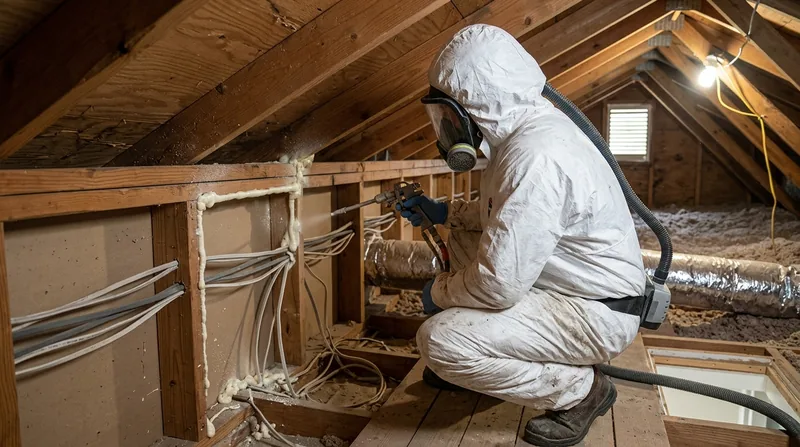




Air sealing in Pensacola stops hot, humid Gulf coast air from leaking through your home's envelope before it overworks your air conditioning. Pensacola's housing stock ranges from historic East Hill cottages to mid-century concrete block ranches in Cordova Park and newer subdivisions spreading toward Pace and Milton. Nearly every attic is vented, which means hot, damp air pushes inward through gaps around top plates, rim joists, and penetrations for most of the year. That constant moisture load, paired with a cooling season that runs from spring through fall, drives energy bills up across older and newer homes alike. We seal the gaps that matter, control where air moves, and do it right the first time.
Why Air Sealing Matters in Pensacola's Hot, Humid Climate
In Pensacola's climate zone 2A, the problem is not winter cold. The problem is that humid air finds every gap it can and pushes inward through walls, attic floors, and rim joists while your air conditioning fights to pull it back out. A vented attic design assumes dry air will escape, but here the air stays damp most of the year. Moisture enters cavities that should stay dry, and that moisture load is what drives energy costs up and comfort down.
- We seal top plates where walls meet the attic to stop air from rising straight into unconditioned space.
- We seal rim and band joists that face the crawl space or exterior to block humid air from entering rim cavities.
- We seal penetrations for electrical, plumbing, and HVAC lines that cut through the thermal envelope.
- We seal around ductwork, recessed lights, and attic hatches that leak conditioned air into the attic.
- We seal the gaps spray foam cannot reach by hand, using closed-cell foam or caulk in tight spots before we spray.
Sealing these leaks stops the moisture and conditioned air from moving where it should not, and your cooling system works less to maintain comfort.
Local example: A 1950s Cordova Park home with a concrete block foundation, vented attic, and rim joists open to the crawl space loses conditioned air and gains humid air through rim cavities and top plate gaps. Sealing those rim joists with closed-cell foam and caulking the top plate stops both the air leak and the moisture path that keeps the attic damp and the cooling bill high.
For more detail on how sealed attics work and the spray foam methods that make them possible, see our attic spray foam insulation page. For guidance on permitting and what applies at your address, the Escambia County Building Department can clarify what your local code requires.
How We Seal Air Leaks in Pensacola Homes
Air sealing is not a single method. It is a sequence of steps that we perform before, during, and after spray foam, because foam alone cannot reach every gap. We inspect the space, identify the leaks that matter most, and seal them in the order that makes sense for your home.
- We walk the attic, crawl space, or rim joist cavity and locate air leaks at top plates, rim joists, ductwork, penetrations, and any opening that connects conditioned space to unconditioned space.
- We caulk small gaps and seal around electrical boxes, plumbing stacks, and duct boots before spray foam is applied.
- We spray closed-cell or open-cell foam into cavities, rim joists, and wall voids to fill the large voids and create an air and moisture barrier.
- We verify that the foam has reached the back of the cavity and that no voids remain where air can still move.
- We allow the foam to cure fully before the space is re-entered or inhabited, per the manufacturer's timeline.
The result is a sealed envelope where air moves only where it is supposed to, and moisture stays out of cavities that should stay dry.
Pensacola example: A Pace subdivision home with a room over an attached garage loses conditioned air and gains heat through the rim joist and the gap where the garage top plate meets the attic. We seal the rim joist cavity with closed-cell foam and caulk the top plate gap, so the room no longer pulls cold air down into the garage and the garage no longer pulls hot air into the conditioned space.
For a detailed look at the closed-cell and open-cell options and when each is the right choice, visit our closed-cell spray foam page or our open-cell spray foam page.
Air Sealing Methods and Where They Work Best
| Method | Description | Best For |
|---|---|---|
| Caulk and sealant | Low-expansion polyurethane or acrylic caulk in small gaps around electrical boxes, plumbing penetrations, and ductwork. | Gaps under 1 inch wide, tight spaces where foam cannot be sprayed, and detail work before foam is applied. |
| Closed-cell spray foam | High-density foam (3.5 to 4.5 lb/cf) that sets hard and forms an air and moisture barrier in one pass. | Rim joists, band joists, wall cavities in older homes, and any cavity where moisture control is critical. |
| Open-cell spray foam | Low-density foam (0.5 to 1 lb/cf) that cures soft and allows moisture to move through it while blocking air. | Attic top plates, wall cavities in newer homes with damp-proof barriers, and interior wall spray where cost is a factor. |
| Weatherstripping and gaskets | Foam tape or rubber gaskets installed around attic hatches, access doors, and ductwork registers to stop air leakage at moving parts. | Attic hatches, access doors, and any hatch or door that opens into unconditioned space. |
Each method seals air leaks, but the choice depends on the cavity, the access, and whether moisture control is a priority. We choose the method that solves your leak and fits your budget.
Air Sealing Cost in Pensacola: What to Expect
Air sealing cost depends on the scope of the job, the size of the home, and the method we use. A small rim joist seal in a single area costs less than sealing the entire top plate of a large attic. Most air sealing jobs in Pensacola start at $650 for a focused project and rise based on the square footage of the envelope, the number of penetrations, and the access difficulty.
Factors that move the price up include the size of the attic or crawl space, the number of rim joist bays to seal, the complexity of the ductwork layout, and whether old insulation needs to be removed first. A small top-plate seal in a 1,200-square-foot East Hill cottage costs less than sealing the rim joists and top plate of a 2,500-square-foot Pace subdivision home. If the job requires insulation removal before sealing, that adds to the cost and timeline.
The best way to know what your job will cost is to get a written estimate with R-value and thickness specifications. We provide free estimates within 24 hours at (850) 903-5081, and we always explain what the number covers and what factors might move it. For a full breakdown of our pricing across all services, visit our pricing page.
What to Look for When Hiring an Air Sealing Contractor Near Pensacola
Air sealing is a detail-oriented job, and the difference between a contractor who seals leaks and one who misses them is inspection and follow-through. When you call contractors in Pensacola, Gulf Breeze, Ferry Pass, or surrounding areas, ask how they verify that every gap is sealed and how they test their work. Get multiple estimates so you can compare method, price, and what each contractor guarantees.
- Verify that the contractor is fully insured and ask to see the certificate of insurance before work begins.
- Ask for references from recent jobs in Pensacola or nearby areas, and call at least one to ask about the quality of the seal and the contractor's responsiveness after the job.
- Check whether the contractor provides a written estimate that names the method, the areas to be sealed, and the R-value or thickness if foam is used.
- Confirm that the contractor understands local permitting rules for your city or county and will help you navigate what applies at your address.
- Ask about the cure time and re-entry window before the space is occupied or used, and verify that the contractor plans for mechanical ventilation during cure if required.
- Understand the workmanship warranty and what it covers, and make sure the contractor can explain why their price is what it is.
Avoid contractors who offer a price far below market with no inspection, promise immediate re-entry, or cannot verify their insurance. The local independent contractor is often a better choice than a rig-and-run crew from out of state or a franchise that handles dozens of markets at once. Call us at (850) 903-5081 or request a free estimate to see how we work and what we can do for your home.
Air Sealing in Pensacola: Pricing Guide
| Service | Price | Details |
|---|---|---|
| Small air sealing project | Starting at $650 | Rim joist bay or single top plate section, includes foam and caulk for detail work |
| Medium air sealing scope | Starting at $1,200 | Multiple rim joist bays or full attic top plate, factors that move this up include home size and access difficulty |
| Large air sealing with insulation removal | On estimate | Removal of failed insulation before sealing, full crawl space or attic envelope, requires site inspection |
| Travel | Included | No separate mileage or travel fee within Pensacola and surrounding service areas |
| Written estimate | Free | Response within 24 hours, includes R-value and thickness specs, no obligation to book |
Indicative pricing, the exact cost depends on square footage, finish, and site access. Free personalized estimate within 24h at (850) 903-5081.


