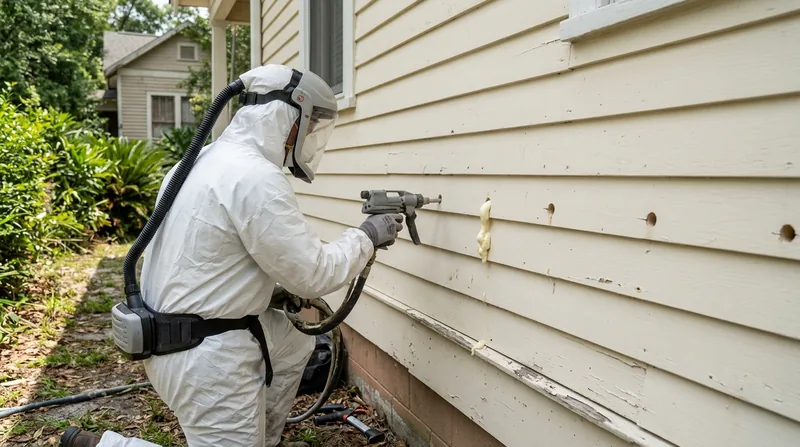




Wall & Injection Foam Insulation in Pensacola addresses a problem most homeowners don't see until their energy bills arrive: the closed wall cavities in East Hill bungalows, Cordova Park concrete block homes, and mid-century ranches across Escambia County trap Pensacola's year-round humidity. Unlike vented attics where air circulates, wall cavities sit sealed and still, collecting moisture from spring through fall and into winter, degrading fiberglass batts and driving up cooling costs when you need it most. Injection foam and open-cavity spray foam retrofit these walls without major demolition, sealing the moisture and air leaks that fiberglass cannot stop. We inject closed-cell or open-cell foam into existing walls, spray open cavities during renovation, and air-seal the perimeter to keep Pensacola's hot, humid air where it belongs: outside. This guide walks you through why wall insulation matters here, how we do it, and what to expect when you call.
Why Wall Insulation Matters in Pensacola: Humidity, Heat, and Hidden Leaks
Pensacola sits in IECC climate zone 2A, hot and humid year-round. Historic cottages in East Hill and North Hill were built with single-layer brick or wood-frame walls insulated with fiberglass batts, if insulated at all. Cordova Park and other mid-century neighborhoods added concrete block construction, which conducts heat and cold directly into living spaces. Modern subdivisions toward Pace and Milton use standard wood framing with batts, but the moisture load is identical: outdoor air pushes inward through walls for nine months of the year, and fiberglass does not stop it. Moisture-laden air finds its way into wall cavities, saturates the batts, and the R-value collapses. Meanwhile, air leaks around outlets, headers, and rim joists pull conditioned air into the walls and unconditioned air into the living space, forcing your air conditioner to run harder and longer.
- Fiberglass batts absorb moisture and lose R-value, especially in Pensacola's humid climate where dew point stays high most of the year.
- Air leaks around electrical outlets, rim joists, and band joists allow conditioned air to escape and unconditioned air to enter, raising cooling costs.
- Concrete block walls conduct heat directly without any insulation between the block and the interior drywall, turning rooms into ovens in summer.
- Sealed foam insulation stops both moisture and air movement, keeping walls dry and living spaces comfortable year-round.
Fixing wall insulation is not glamorous like a new roof, but it is one of the highest-return retrofits you can make in an older Pensacola home.
Key info: A 1950s Cordova Park block home with uninsulated walls can see cooling costs 20 to 30 percent higher than a similar home with foam-sealed cavities, especially in rooms facing west or south. In East Hill cottages, moisture-saturated wall insulation is often invisible until you open a wall for renovation and find soggy batts or mold growth on the interior of the sheathing.
For regulatory guidance on wall insulation in Pensacola, the Escambia County Building Department publishes the energy code and thermal barrier requirements that apply to spray foam work in your address. Permitting and thermal barrier rules vary by city, so confirm what applies to your job before work starts.
How Wall & Injection Foam Insulation Works: The Pensacola Retrofit Process
Injection foam and spray foam retrofit work differently depending on whether the wall is already closed or open during renovation. If the wall is closed (the standard retrofit in existing homes), we drill small holes in the drywall or exterior sheathing, inject expanding foam into the cavity, and patch the holes. If the wall is open during renovation or new construction, we spray foam directly into the cavity, building coverage to the specified R-value and thickness. Both methods create an air seal and a thermal barrier that fiberglass cannot match. We work with closed-cell spray foam for maximum R-value and moisture resistance, or open-cell foam for cost-effective coverage and sound dampening in non-critical walls.
- We locate studs, outlets, and structural members using a stud finder and inspect the wall cavity for moisture, pests, or obstructions before any foam is applied.
- For closed walls, we drill 1-inch holes spaced 16 inches apart, inject expanding foam, and patch with foam-compatible sealant and drywall compound.
- For open walls during renovation, we spray foam to the full depth of the cavity, typically 3.5 to 5.5 inches, achieving R-13 to R-21 depending on foam type and thickness.
- We air-seal around the perimeter, including headers, rim joists, and band joists, so the foam job stops air leaks throughout the wall assembly.
- We ventilate the space during cure and confirm a re-entry window of 24 to 48 hours before drywall or exterior work resumes.
The result is a wall cavity that stays dry, resists air infiltration, and maintains its R-value for decades.
Local example: A Ferry Pass homeowner with a 1960s ranch discovered moisture damage in the exterior wall of a bedroom during renovation. Instead of tearing out the entire wall, we injected closed-cell foam into the cavities from inside, sealed the rim joist above, and patched the holes. The wall dried out, the bedroom stayed comfortable, and the job cost a fraction of what full wall replacement would have been.
Wall & Injection Foam Insulation Methods: Closed vs. Open Cavities
| Approach | Description | Best for |
|---|---|---|
| Injection Foam (Closed Walls) | Drill small holes, inject expanding foam, patch holes. No drywall removal. Minimal disruption. | Existing homes, retrofit work, occupied spaces, walls with finished drywall or siding. |
| Open-Cavity Spray Foam | Spray foam directly into open framing during renovation or new construction. Full coverage to studs and headers. | New construction, major renovations, additions, rooms being gutted to the studs anyway. |
| Closed-Cell Foam | Higher R-value per inch (R-6 to R-7), moisture resistant, vapor barrier. Denser, more rigid. | Exterior walls, below-grade spaces, areas prone to moisture or air infiltration, maximum performance needed. |
| Open-Cell Foam | Lower R-value per inch (R-3.5 to R-4), softer, sound-dampening, vapor-permeable. Lower cost. | Interior walls, sound control, budget-conscious retrofits, walls not exposed to weather or moisture. |
Wall & Injection Foam Insulation Cost in Pensacola: What to Expect
Wall and injection foam insulation in Pensacola typically starts at $2 per square foot for open-cavity spray foam on new construction or major renovation, and rises from there depending on foam type, cavity depth, and whether the wall is already closed. Closed-wall injection work costs more per square foot because of drilling, hole patching, and the labor to locate studs and avoid wiring. A typical retrofit of a 500-square-foot wall section with closed-cell foam injection runs $1,200 to $2,000; open-cavity spray foam on the same area during renovation runs $1,000 to $1,600. The biggest cost drivers are foam type (closed-cell costs more than open-cell), the depth of the cavity (deeper cavities hold more foam), and access (walls that require scaffolding or interior demolition cost more to prepare).
Travel is included throughout Pensacola and surrounding areas, so you do not pay a separate mileage fee. Get a free written estimate that specifies R-value, thickness per pass, and foam type so you can compare apples to apples with other contractors. Call us at (850) 903-5081 to schedule your on-site assessment; we respond within 24 hours and there is no obligation to book.
Factors that move cost up or down include the size of the wall area, whether the wall is exterior or interior, whether studs or structural members are present (and if we need to work around them), and whether the wall already has failed insulation that needs removal first. Insulation removal is a separate line item if the old batts are wet, moldy, or need to come out before foam goes in. Always get 2 to 3 estimates so you understand the range and the reasoning behind each price.
Wall & Injection Foam Insulation Near Me: What Pensacola Homeowners Should Know When Hiring
Hiring a spray foam contractor for wall insulation is a decision that affects your home's comfort and resale value, so take time to verify credentials and understand the work before you sign. A reputable contractor will provide a written estimate with R-value and thickness clearly stated, explain whether a permit is required at your address, and be reachable by phone if questions come up after the job. Check that the contractor carries liability and property damage insurance (we are fully insured and carry a certificate of insurance available on request). Ask for references from recent jobs in Pensacola or nearby areas, and call at least two to confirm the work was done on time and to spec.
- Request a written estimate that specifies R-value, foam thickness per pass, foam type (closed-cell or open-cell), and the square footage being covered.
- Confirm that mechanical ventilation will be running during foam cure and that a re-entry window of 24 to 48 hours is guaranteed before finishing work resumes.
- Ask whether a permit is required for your address and your city, and verify that the contractor understands the thermal barrier and ignition barrier rules that apply to spray foam in your jurisdiction.
- If the wall is in an HOA community or historic district, check architectural guidelines before work begins; spray foam itself is rarely restricted, but exterior access or scaffolding may be.
- Never accept an estimate with no R-value, no thickness spec, or a price far below market; these are markers of a rig-and-run outfit that may not finish the job or answer calls later.
When you are ready to move forward, contact us for a free estimate at (850) 903-5081. We have been in business since 2011, we know Pensacola's housing stock and climate inside and out, and we stand behind every job we spray.
Wall & Injection Foam Insulation in Pensacola: Pricing Guide
| Service | Price | Details |
|---|---|---|
| Open-Cavity Spray Foam (New Construction or Renovation) | Starting at $2/sq ft | Open walls with full stud exposure. Includes foam to specified R-value, air sealing at headers and rim joists, mechanical ventilation during cure |
| Closed-Wall Injection Foam (Retrofit, Existing Homes) | Starting at $3/sq ft | Drilling, injecting, and patching closed walls. Higher labor cost due to hole location, stud finding, and foam-compatible patching compound |
| Closed-Cell Foam (Maximum R-Value and Moisture Resistance) | Starting at $2.50/sq ft | Higher R-value per inch, vapor barrier properties, denser structure. Costs more than open-cell but outperforms in humid or exterior-facing walls |
| Insulation Removal and Replacement | On estimate | Removal of wet, failed, or contaminated insulation is priced separately. Add to foam cost if old insulation must come out first |
| Travel and Estimate | Included / Free | No mileage fee within Pensacola and surrounding areas. Free written estimate with R-value, thickness, and foam type specified |
Indicative pricing, the exact cost depends on square footage, finish, and site access. Free personalized estimate within 24h at (850) 903-5081.


