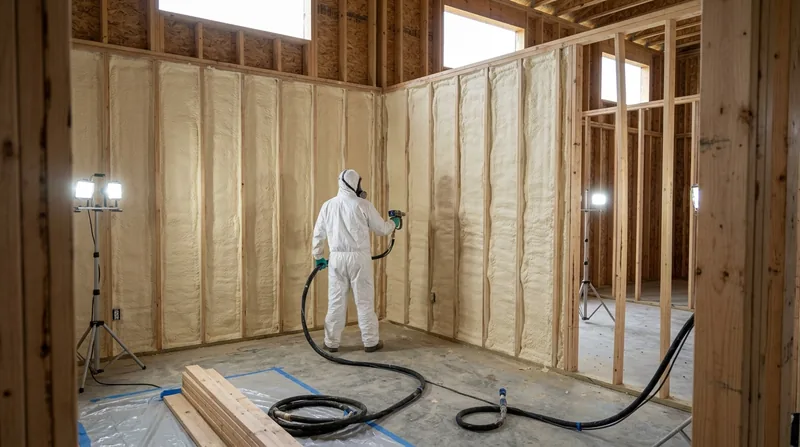




Commercial and new construction spray foam insulation in Pensacola requires a building envelope that holds up to the Gulf Coast's relentless heat and humidity. New builds across Escambia and Santa Rosa counties are framed and dried in, mechanical and electrical rough-in is complete, and the structure sits open to the elements while you choose how to seal it. Existing commercial spaces from Pensacola to Gulf Breeze run HVAC year-round because their walls and roofs leak conditioned air into a hot, damp climate that never stops pushing moisture inward. Whether you are closing out a new shell or tightening an older commercial building, spray foam and air sealing deliver the continuous envelope that vented insulation cannot match. We spray foam new builds and retrofit commercial spaces across the county for a tighter building envelope, lower operating costs, and conditioned space that stays dry. Call us at (850) 903-5081 for a free commercial estimate, or read on to understand how spray foam works for new and existing commercial projects.
Why Commercial and New Construction Spray Foam Matters in Pensacola's Climate
Pensacola's hot and humid climate zone 2A puts constant pressure on building envelopes. Moisture drives inward through walls and roof decks for most of the year, and a vented attic or traditional fiberglass cavity insulation assumes that moisture will escape somewhere it actually does not. New construction framers in Ferry Pass, Milton, and Pace build fast, and the structure sits open for weeks or months while mechanical and electrical work proceeds. That open time is when humidity soaks into framing, cavities, and rim joists. A sealed roof deck or closed-cell foam envelope stops that moisture at the boundary and keeps the interior dry from day one. For commercial buildings in Warrington or Bellview running HVAC twelve months a year, a sealed envelope cuts the load on cooling equipment and holds indoor humidity steady instead of fighting a constant battle against infiltration.
- Sealed roof decks and wall cavities stop moisture from soaking into framing during construction and operation.
- Closed-cell foam creates an air barrier that reduces HVAC load and holds conditioned space stable in hot, humid conditions.
- New construction spray foam applied during framing eliminates the need for secondary air sealing later.
- Commercial retrofits on older concrete-block buildings in Cordova Park or Ensley gain insulation value and air sealing in one pass.
- Metal buildings and shops across Escambia and Santa Rosa counties use closed-cell foam to control condensation on steel that vented insulation cannot prevent.
A sealed building envelope is not optional in this climate; it is the foundation of comfort and durability.
Key info: New construction in Pensacola, Gulf Breeze, and Pace sits open to humidity for weeks during framing and rough-in. Spray foam applied at the roof deck and walls before drywall closes out the building stops moisture infiltration and sets the envelope right from the start. Older commercial buildings in Ferry Pass or Bellview with vented attics or open crawl spaces lose conditioned air and take on humidity year-round; sealed retrofit foam recovers that space and reduces operating costs.
How We Spray Foam New Construction and Commercial Buildings in Pensacola
New construction spray foam work begins during framing, before drywall and roofing close out the building. We assess the roof deck, wall cavities, rim joists, and any crawl space or basement, measure the square footage and cavity depth, and apply foam in controlled passes. Closed-cell foam is the standard for new construction because it delivers high R-value in thinner passes, creates a vapor barrier that stops moisture, and provides structural support to the roof deck. Commercial retrofits on existing buildings require a site survey first: we identify what is currently in place, whether it is sound, and what needs to be removed or sealed over. If old insulation or contamination is present, we remove it and dispose of it properly before foam goes in. Mechanical ventilation runs during application and for the manufacturer-specified cure window (typically 24 to 48 hours) to manage off-gassing and keep the space safe during cure.
- We conduct a free on-site survey of the building envelope, roof deck, walls, and rim joists to determine square footage and cavity depth.
- We provide a written estimate with R-value and thickness specifications for the foam system recommended for your building.
- We schedule the spray during a window when the building can be closed off or ventilated during the cure period.
- We apply foam in controlled passes, checking thickness and coverage to match the estimate and the manufacturer specification.
- We run mechanical ventilation throughout application and the full cure window, with a posted re-entry schedule so your crews know when the space is safe to occupy.
- We seal air leaks at rim joists, band joists, and penetrations so the foam envelope is continuous and effective.
The result is a building envelope that holds insulation value and controls moisture from the day it is sealed.
Example: A new commercial building shell in Warrington is framed with a vented attic and open rim joists. Moisture soaks into the framing during construction and the first cooling season. We spray closed-cell foam on the roof deck (sealed attic), rim joists, and band joists before drywall and roofing go on. The building is sealed tight, interior humidity stays low, and the HVAC system runs efficiently from day one. Compare that to a retrofit on an older Cordova Park office building with a vented attic and fiberglass cavity insulation that has absorbed humidity for twenty years. We remove the old insulation, seal the roof deck with closed-cell foam, and air-seal the rim and band joists. The building no longer leaks conditioned air and moisture, and operating costs drop.
Spray Foam Methods for New Construction and Commercial Projects
| Approach | Description | Best for |
|---|---|---|
| Closed-cell spray foam (sealed roof deck) | High-density foam applied to the underside of roof decking or attic floor; creates a continuous air and vapor barrier; typical thickness 1.5 to 3 inches for R-6 to R-18 per inch. | New construction roofs and commercial retrofits in Pensacola and Gulf Breeze where moisture control and structural support matter; metal buildings where condensation control is critical. |
| Closed-cell cavity fill (walls and rim joists) | Closed-cell foam injected into wall cavities, rim joists, and band joists; fills cavities completely and seals air leaks at framing penetrations. | New construction walls before drywall; commercial building rim and band joists; retrofit wall cavities in concrete-block buildings where cavity insulation is the only option. |
| Open-cell spray foam (attics and sound control) | Lower-density foam applied to attic floors or interior walls; R-3.5 to R-4 per inch; breathable, so it does not trap moisture; softer texture allows mechanical ventilation. | New construction attics where venting is required or desired; commercial spaces where sound dampening is a priority; retrofit attics in Pace or Milton where the roof stays vented. |
| Air sealing and foam perimeter | Foam applied to rim joists, band joists, around penetrations (ducts, pipes, electrical), and at top and bottom plates to seal the building envelope; often 1 to 3 inches thick. | Every new construction and retrofit project; the difference between a sealed envelope and one that leaks; required on commercial buildings in Bellview, Warrington, and Ferry Pass. |
Commercial and New Construction Spray Foam Cost in Pensacola: What to Expect
Cost for commercial and new construction spray foam depends on the size of the building envelope, the type of foam (closed-cell or open-cell), the thickness and R-value specified, and whether existing insulation must be removed first. A new construction shell in Pace or Milton with a 3,000-square-foot roof deck and 500 linear feet of rim joists typically ranges from several thousand dollars to tens of thousands, depending on foam type and thickness. A commercial retrofit on an older Pensacola office building with an attic and crawl space may cost more because removal of failed or contaminated insulation adds labor and disposal. The best way to understand cost for your project is to request a free commercial estimate; we measure the space, specify R-value and thickness in writing, and give you a firm quote before work begins.
Factors that move cost up or down include the complexity of the building (metal frame, concrete block, or wood), the height and pitch of the roof, access for equipment, whether ducts or mechanical systems are in the way, and the local permitting and inspection schedule. A straightforward new construction job with clear access and no obstacles costs less per square foot than a retrofit in a tight commercial space where crews must work around existing equipment and tenants. Getting multiple estimates is always smart; compare the R-value and thickness specification, the equipment and ventilation plan during cure, the warranty on workmanship, and the timeline. See our full pricing overview for typical ranges and what is included at each level.
What to Look for When Hiring a Spray Foam Contractor Near Pensacola
When you are evaluating spray foam contractors near Pensacola for a new construction or commercial project, start with verification of insurance and references. Ask for proof of liability and property damage coverage, and call two or three past clients to confirm the work was done on time and the space stayed dry and comfortable. Get written estimates from at least two contractors; a real estimate includes R-value and thickness, the equipment and ventilation plan during cure, a re-entry timeline, and a workmanship warranty period. Avoid any estimate that is vague on thickness, promises immediate re-entry, or quotes a price far below market without explanation. Permitting and inspection vary by city across Greater Pensacola; the contractor should know what applies at your address and help you navigate local requirements without doing the permitting themselves. For commercial projects, check whether your building or HOA has architectural or design guidelines that govern exterior work or material choices; spray foam itself is not usually restricted, but the contractor should be aware of any local rules.
The strongest signal of a professional spray foam installer is honesty about what the product can and cannot do. Spray foam is not a roof repair, it does not fix standing water in a crawl space, and it does not remediate mold or contamination. If a contractor promises to spray over a wet or compromised substrate, walk away. The right contractor will say "we fix the moisture first or we walk away," and that is a sign you are dealing with someone who understands the trade and will not leave you with a problem after they leave. Contact us for a free estimate and a straightforward conversation about what your building needs and what spray foam can deliver.
Commercial & New Construction Spray Foam in Pensacola: Pricing Guide
| Service | Price | Details |
|---|---|---|
| Free commercial estimate | Free | On-site survey of roof deck, walls, rim joists, and existing insulation; written specification with R-value and thickness; no obligation |
| New construction sealed roof deck (closed-cell) | Starting at $1.50-$2.50 per board foot | Typical 1.5 to 3 inches thick; cost depends on roof size, pitch, and access; includes air sealing at perimeter |
| Commercial retrofit (existing building) | Starting at $2.00-$3.50 per board foot | Includes removal and disposal of old insulation if present; sealed roof deck and rim joist work; cost higher if asbestos survey or abatement required |
| Rim and band joist sealing | Starting at $500-$1,500 | Linear footage and cavity depth determine final cost; typically 1 to 2 inches of closed-cell foam; air sealing at all penetrations included |
| Metal building or barndominium | Starting at $1.75-$2.75 per board foot | Closed-cell foam controls condensation on steel; cost depends on building size, roof pitch, and whether walls are included |
| Travel and scheduling | Included | No mileage fee or travel charge in Pensacola and surrounding service areas; scheduling coordinated around your construction timeline |
Indicative pricing, the exact cost depends on square footage, finish, and site access. Free personalized estimate within 24h at (850) 903-5081.


