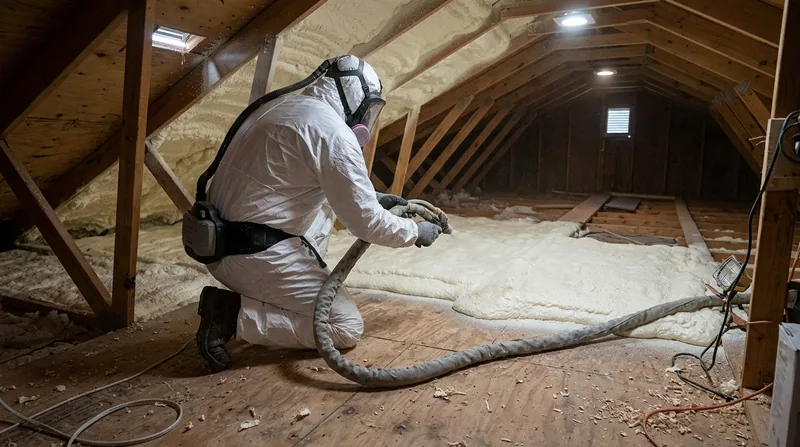




Old fiberglass insulation in Pensacola attics absorbs moisture from the Gulf humidity and loses R-value year after year. When vented attic design pulls hot, damp air through the soffit for most of the cooling season, the insulation beneath it never dries out completely. Insulation replacement and re-insulation removes the failed material and installs new spray foam or blown-in insulation that actually performs in this climate. Historic East Hill cottages, mid-century Cordova Park ranches, and newer subdivisions stretching toward Pace all face the same problem: aging fiberglass that works harder every humid month and delivers less. We pull the old material and install new insulation across attic floors, walls, and rim joists from Pensacola to Milton and beyond. The payoff is a home that holds temperature better, runs its air conditioning less often, and stays more comfortable through the long cooling season.
Why Insulation Replacement Matters in Pensacola's Hot, Humid Climate
Pensacola's vented attics were designed for a dry climate. Here, they pull in hot, damp air from May through October and often into November. Fiberglass batts and blown-in fibers absorb that moisture, compress over time, and stop resisting heat transfer. A home built in the 1980s in East Hill or a 2000s-era ranch in Cordova Park may have lost 30 to 50 percent of its original R-value by now. Energy bills climb, rooms stay hot, and the air conditioning runs longer than it should. Replacing worn-out insulation with spray foam or dense blown-in material stops the moisture problem at the source and seals the air leaks that vented designs always leave behind.
- We remove old fiberglass, cellulose, or failed foam completely before installing new material.
- Spray foam insulation seals every cavity and eliminates the air leaks that fiberglass leaves open.
- Dense blown-in insulation over attic floors delivers high R-value in a single pass without the moisture trap.
- We inspect the attic for roof leaks, damaged decking, or pest damage before we insulate.
- Proper attic ventilation or sealed roof deck design is confirmed with the local building code at your address.
A failed attic insulation job is the single biggest driver of high cooling bills in Pensacola homes. Replacing it is one of the highest-return upgrades a homeowner can make.
Key info: Pensacola's long cooling season means your attic insulation is working hard from April through November. Moisture from the Gulf humidity stays trapped in old fiberglass, which loses R-value and stops performing. Replacement with spray foam or dense blown-in insulation fixes both problems at once. Learn more about attic spray foam insulation as the permanent solution.
For details on local permitting and code requirements in Pensacola, contact the City of Pensacola Building Department or your local city office. Ventilation and thermal barrier requirements vary by jurisdiction across Escambia and Santa Rosa counties.
How Insulation Replacement Works: Step by Step in Pensacola
Replacing attic insulation or wall insulation is a sequence that starts with removal and ends with air sealing. We inspect the existing material, plan the tearout, remove everything safely, prepare the substrate, and install new insulation to specification. The job size, substrate condition, and choice of foam or blown-in material all affect timeline and cost. A small attic top-up in Bellview takes one day. A full crawl space or wall injection retrofit in Ferry Pass or Warrington takes longer and often requires mechanical ventilation during cure.
- We inspect the attic or wall cavity and identify the existing insulation type, R-value, and any moisture or damage.
- We remove all old insulation, debris, and contaminated material in sealed bags and haul it away.
- We inspect and repair the roof deck, wall studs, rim joists, or floor framing for leaks, rot, or pest damage.
- We seal air leaks around electrical penetrations, plumbing, ductwork, and rim cavities before insulation goes in.
- We install new spray foam or blown-in insulation to the R-value and thickness specified for your climate zone.
- We verify thickness and coverage with a handheld gauge and provide a written record of R-value and board feet installed.
The result is an attic or wall cavity that performs as designed and stays dry even in Pensacola's humid climate.
Real example: A 1970s-era home in East Hill with a vented attic and original fiberglass batts. The homeowner noticed energy bills climbing and rooms staying hot. We removed 2,000 square feet of compressed, moisture-logged fiberglass, sealed the rim cavity and ductwork penetrations, and installed 6 inches of open cell spray foam across the attic floor. The attic stayed dry, the house stayed cooler, and the air conditioning ran less often. Learn about insulation removal as the first step in any retrofit.
Insulation Replacement Methods: Spray Foam vs. Blown-In Material
| Approach | Description | Best for |
|---|---|---|
| Open Cell Spray Foam | Low-density foam sprayed to 5-6 inches, expands to fill cavities, flexible once cured, permits vapor diffusion. | Attic floors in vented designs where moisture control is secondary to R-value and air sealing. |
| Closed Cell Spray Foam | High-density foam sprayed to 2-3 inches, creates vapor barrier, rigid once cured, resists moisture absorption. | Sealed attic decks, crawl spaces, wall cavities, rim joists, and metal buildings where condensation control is critical. |
| Dense Blown-In Insulation | Cellulose or fiberglass blown to 10-12 inches over attic floor, settles over time, non-combustible, good for vented attics. | Attic top-ups where existing vented design is sound and a lower price point is the priority. |
| Injection Foam into Walls | Low-pressure foam injected into closed wall cavities through small holes, expands to fill voids, no demolition required. | Retrofit of pre-1980 concrete block or wood-frame homes in Cordova Park and historic districts without opening walls. |
The right choice depends on your attic design, the climate zone, and your budget. A vented attic with sound structure and low moisture may benefit from dense blown-in material. A sealed attic deck, a crawl space, or a home with wall cavities benefits from spray foam. We help you choose based on your home's actual condition, not on price alone.
Insulation Replacement and Re-Insulation Cost in Pensacola: What to Expect
Insulation replacement pricing starts at $2,800 for a small attic top-up and rises with square footage, removal complexity, foam type, and access difficulty. A 1,500-square-foot attic tearout and spray foam install costs more than a simple blown-in top-up of sound insulation. A crawl space or wall injection retrofit adds labor and material cost. Travel is included in our service area across Pensacola, Gulf Breeze, Ferry Pass, Warrington, Bellview, and surrounding areas. We provide a written estimate that specifies R-value, thickness, square footage, and the total cost before we schedule the job.
- Square footage of the attic floor or wall cavity is the primary cost driver for any insulation job.
- Removal of old material, disposal, and substrate prep add cost but are necessary for a sound installation.
- Spray foam (open or closed cell) costs more than blown-in insulation but seals air leaks and resists moisture.
- Access difficulty, roof pitch, or the need for scaffolding or mechanical ventilation can increase the final price.
- We never quote a price per board foot or per square foot until we inspect the space and confirm the scope.
The best way to understand cost for your home is to review our pricing overview and request a free, no-obligation estimate. We respond within 24 hours at (850) 903-5081.
Insulation Replacement and Re-Insulation Near Me: What Pensacola Homeowners Should Know Before Hiring
Hiring the right contractor for insulation replacement means verifying insurance, understanding the estimate, and confirming that the installer knows local code. Many spray foam contractors operate as traveling crews with no local address or verifiable insurance. Others promise faster or cheaper work by cutting corners on thickness, ventilation during cure, or substrate preparation. A local, established shop with a Pensacola address, fully insured coverage, and a written estimate with R-value and thickness specs is your safest choice.
- Confirm that the contractor carries full insurance and can provide a certificate of coverage before work starts.
- Get at least two or three written estimates that specify R-value, thickness in inches, square footage, and total cost.
- Ask for references from recent jobs in Pensacola, Gulf Breeze, or Warrington and call them to ask about quality and follow-up.
- Verify that the contractor understands local permitting, ventilation code, and thermal barrier requirements for your address.
- Check whether your HOA has architectural rules that govern exterior work on metal buildings or additions.
- Ask about the re-entry window (typically 24 to 48 hours for spray foam) and mechanical ventilation during cure.
A contractor who walks you through the estimate, answers your questions honestly, and can explain why one approach is better than another for your home is worth the conversation. Contact us for a free estimate and see how we approach your job.
Insulation Replacement & Re-Insulation in Pensacola: Pricing Guide
| Service | Price | Details |
|---|---|---|
| Attic insulation replacement (tearout and blown-in top-up) | Starting at $2,800 | Removal of old insulation, disposal, and dense blown-in material to 10-12 inches over 800-1,200 square feet |
| Attic insulation replacement with spray foam | Starting at $4,200 | Complete removal, substrate inspection and repair, air sealing, and open or closed cell spray foam to specification |
| Crawl space or wall cavity re-insulation | Starting at $3,800 | Removal, encapsulation prep, and spray foam installation with mechanical ventilation during cure and extended re-entry window |
| Large-scale retrofit or complex substrate | On estimate | Multi-zone attic, failed previous foam, structural damage, or contaminated material requires on-site inspection before pricing |
| Travel and estimate | Included and free | No mileage fees or travel charges within Pensacola, Gulf Breeze, Ferry Pass, Warrington, Bellview, and surrounding service areas |
Indicative pricing, the exact cost depends on square footage, finish, and site access. Free personalized estimate within 24h at (850) 903-5081.


