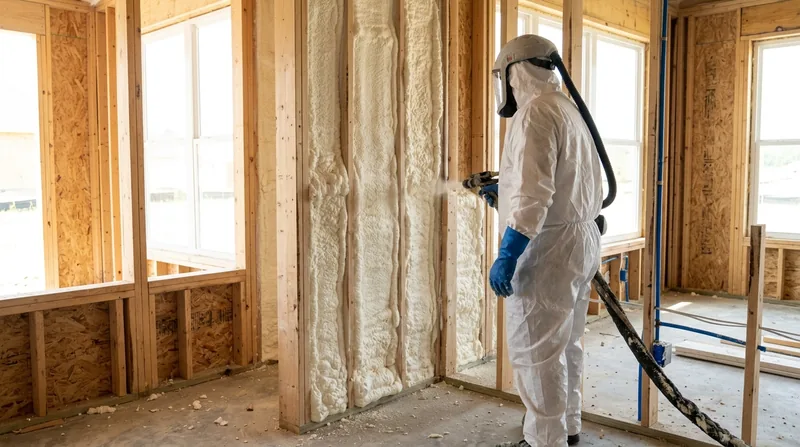




Open Cell Spray Foam Insulation in Pensacola fills the stud cavities and attic rafters of older East Hill cottages, Cordova Park mid-century concrete block ranches, and newer subdivisions stretching toward Pace and Milton. Pensacola's hot and humid climate, paired with vented attics that pull in moisture-laden air for most of the year, drives energy bills higher than they need to be. Open cell foam expands to seal gaps, fills cavities completely, and stops the constant inward flow of hot, damp air that conditioned spaces fight against from spring through fall. Unlike closed cell foam, open cell is lower-density, more affordable, and absorbs sound, making it ideal for attics and interior walls where you want both thermal control and acoustic dampening. This page explains how open cell spray foam works in Pensacola homes, what to expect on cost, and how to hire a contractor you can trust.
Why Open Cell Spray Foam Insulation Matters in Pensacola's Hot and Humid Climate
Pensacola sits in IECC climate zone 2A, where humidity stays high year-round and the cooling season stretches from spring through fall. Vented attics, the standard in most Pensacola homes, pull in that hot, damp air instead of simply exhausting dry air out. The result is moisture creeping into wall cavities and attic floors through most months, moisture that fiberglass batts and blown-in cellulose assume will escape but often does not. Open cell foam seals those cavities completely and stops the moisture infiltration at the source. It is also more affordable than closed cell foam, making it the right choice when your goal is thermal sealing and moisture control in a vented attic or interior wall cavity.
- Open cell foam expands to fill stud cavities, rim joists, and attic rafter bays completely, closing gaps that fiberglass leaves open.
- The material is permeable to water vapor, meaning it does not trap moisture inside the cavity the way closed cell foam can.
- Lower density and lower cost per board foot make open cell the practical choice for attics and interior walls where R-value per dollar matters.
- Open cell absorbs sound, reducing airborne noise from outside traffic, aircraft, and neighboring properties, a significant benefit in older neighborhoods and near flight paths.
- The foam cures to a semi-rigid state, staying in place without sagging or settling over decades like blown-in fiberglass or cellulose.
For homeowners in Pensacola looking to cut energy bills and stop the seasonal moisture cycle, open cell spray foam is the most cost-effective way to seal an attic or retrofit interior walls.
Key info: Pensacola's vented attics pull in hot, damp air for eight to ten months every year. Open cell foam seals that leakage path and stops the moisture infiltration that drives higher cooling bills and faster fiberglass degradation in older homes from East Hill to Cordova Park and new builds toward Gulf Breeze.
For more detail on how spray foam handles moisture and energy loss, see our guide to Attic Spray Foam Insulation.
How We Install Open Cell Spray Foam Insulation in Pensacola Attics and Walls
Open cell spray foam installation starts with a thorough site inspection to identify air leaks, moisture sources, and the scope of coverage needed. We measure the attic or wall cavity, calculate the board footage required to reach the target R-value, and prepare the substrate. If existing insulation is present and degraded, we remove it first. The spray application happens in controlled passes, building thickness gradually to avoid over-application that can sag or cure unevenly. Mechanical ventilation runs during cure to manage off-gassing, and we establish a re-entry window of twenty-four to forty-eight hours before occupants return to the space.
- We inspect the attic or wall cavity for moisture, mold, or structural damage and address any water intrusion before foam goes down.
- Existing insulation is removed if it is wet, compressed, or contaminated, and the substrate is cleaned and dried.
- We apply open cell foam in multiple thin passes, controlling thickness and density to meet the R-value and building code requirements for your address.
- Mechanical ventilation is deployed during cure to exhaust volatile organic compounds, and we communicate the re-entry timeline clearly before we leave the job.
- Once cured, the foam is trimmed flush to the framing and left exposed or covered with drywall or netting per code and your preference.
The entire process from estimate to cure typically takes three to five days, depending on job size and weather.
Example: A 1,200-square-foot attic in a Pace subdivision with six inches of degraded fiberglass takes two days to remove the old insulation and spray four to five inches of open cell foam to R-19 density. The homeowner stays out for forty-eight hours while the foam cures, then the attic is sealed and ready to perform.
Learn more about the air sealing work that often accompanies spray foam in our Air Sealing guide.
Open Cell vs. Closed Cell Spray Foam: Methods and Applications
| Approach | Description | Best for |
|---|---|---|
| Open Cell Foam | Lower-density foam that expands fully, is permeable to vapor, and provides R-3.6 to R-3.8 per inch. Cures semi-rigid and absorbs sound. | Attics, interior walls, and sound dampening. Vented attics where vapor permeability is an asset. Cost-conscious retrofits in Pensacola homes. |
| Closed Cell Foam | Higher-density foam with closed cell structure, R-6 to R-7 per inch, vapor-impermeable. Rigid when cured, adds structural strength. | Metal buildings, sealed attics, rim joists, and crawl spaces where moisture vapor must be blocked. Unvented attics and high-humidity environments. |
| Open Cell + Blown-In | Spray four inches of open cell foam to seal air leaks, then top up with blown-in cellulose or fiberglass to reach target R-value affordably. | Large attics where budget is tight. Existing attics that need air sealing but do not require a complete tear-out and replacement. |
| Injection Foam (Closed Cell) | Closed cell foam injected into existing wall cavities through small holes, no demolition. Expands and fills the cavity completely. | Retrofit insulation in pre-1980 East Hill cottages and older Cordova Park homes. Walls that cannot be opened without structural disturbance. |
Open cell foam is the entry point for most Pensacola homeowners because the cost per board foot is lower and the material performs well in vented attics. If you need vapor blocking, higher R-value per inch, or structural reinforcement, closed cell foam is the upgrade. For injection foam retrofit work in older walls, see our Wall & Injection Foam Insulation page.
Open Cell Spray Foam Insulation Cost in Pensacola: What to Expect
Open cell spray foam in Pensacola starts at approximately $0.55 per board foot and typically ranges from $0.55 to $0.75 per board foot installed, depending on accessibility, substrate condition, and the thickness required to meet your target R-value. A typical attic project of 1,200 to 1,500 square feet with four to six inches of foam runs between $2,500 and $4,500. Interior wall retrofit projects are smaller in scope and cost $1,200 to $2,500 per wall section. The final cost depends on several concrete factors: the size of the area to be sprayed, whether existing insulation must be removed first, the condition of the substrate (wet, moldy, or contaminated substrates require remediation before foam can go down), access to the space (tight attics or crawl spaces take longer and cost more), and the target R-value (higher R-values require thicker foam).
Getting two or three written estimates from different contractors is essential. Each estimate should specify the R-value, the thickness in inches, the board footage, and the total installed price. Estimates that lack these details or offer a price far below market typically signal shortcuts in application or incomplete work. Visit our Pricing page for a detailed breakdown of typical costs and factors that affect the final quote.
We provide free written estimates with R-value and thickness specifications included. Call us at (850) 903-5081 to schedule a no-obligation site visit.
What to Look for When Hiring an Open Cell Spray Foam Contractor Near Pensacola
Spray foam installation is a technical trade, and the difference between a careful installer and a rig-and-run crew shows up months or years later when the smell does not fade or the foam settles unevenly. Start by verifying that any contractor you consider is fully insured and carries liability and workers compensation coverage. Ask for proof of insurance and do not hesitate to contact the insurance carrier to confirm the policy is active. Get multiple written estimates, each with R-value, thickness, and board footage clearly stated. Check references from recent jobs in Pensacola, and ask those homeowners about the cure window, whether mechanical ventilation was used, and whether re-entry happened on schedule.
- Verify that the contractor is fully insured with active liability and workers compensation coverage before signing any agreement.
- Request written estimates from at least two contractors, each specifying R-value, thickness in inches, and total board footage.
- Ask whether the contractor will remove existing insulation if it is wet or degraded, and confirm that cost is included in the estimate or clearly separated.
- Confirm that mechanical ventilation will be used during cure and that a re-entry window of twenty-four to forty-eight hours will be observed and communicated in writing.
- Check local building department requirements for your address, particularly if your home is in a historic district like East Hill or subject to HOA rules, and verify the contractor understands what permits apply.
- Call references from recent jobs and ask about the contractor's responsiveness, cleanup, and whether the work met expectations.
The best contractor is the one who takes time to inspect your space, answers your questions clearly, provides a detailed estimate, and is reachable after the job is complete. Contact us for a free estimate and to discuss your insulation needs.
Open Cell Spray Foam Insulation in Pensacola: Pricing Guide
| Service | Price | Details |
|---|---|---|
| Open Cell Spray Foam (Attic) | Starting at $0.55/board ft | Typical 1,200 to 1,500 sq ft attic with 4 to 6 inches of foam, existing insulation removal included |
| Open Cell Spray Foam (Interior Wall) | Starting at $0.55/board ft | Single wall section retrofit or new construction cavity fill, measured and quoted per board foot on site |
| Substrate Preparation & Removal | Included or itemized | Wet, moldy, or degraded insulation removal and substrate cleaning are included or separated in the estimate depending on scope |
| Large or Complex Projects | On estimate | Multi-story retrofits, metal buildings, or jobs requiring extensive air sealing require a detailed site inspection before pricing |
| Travel | Included | No mileage fee or travel charge for Pensacola and surrounding service areas within our territory |
| Estimate | Free | Written estimate with R-value and thickness specifications, response within 24 hours at (850) 903-5081 |
Indicative pricing, the exact cost depends on square footage, finish, and site access. Free personalized estimate within 24h at (850) 903-5081.


