Understanding R-Value and Why It Matters for Your Attic
When homeowners in Pensacola start researching insulation upgrades, one number keeps appearing: R-value. This rating measures how well a material resists heat flow, and it's the foundation of any smart insulation decision. Higher R-values mean better thermal resistance, which translates directly to lower energy bills and more consistent indoor temperatures year-round.
The tricky part is understanding how much R-value you actually need. That depends on your climate zone, your home's construction, and local building codes. Florida's climate is warm and humid, which means your cooling demands are high, but your heating needs are minimal compared to northern states. Still, proper attic insulation prevents hot air from radiating into living spaces during summer and maintains comfort during the occasional cold snap. Knowing the spray foam insulation r value per inch helps you compare products fairly and understand whether a partial upgrade or a complete re-insulation makes financial sense.
Florida's R-Value Requirements and Your Home's Baseline
Florida building codes specify minimum R-value requirements for attic insulation, and these standards exist to ensure energy efficiency and occupant comfort. For most residential attics in our region, the recommended minimum is R-30 to R-38, depending on whether you're in a new build or retrofitting an existing home. If your attic was insulated 15 or 20 years ago, it likely falls short of today's standards, and the material may have settled or degraded over time.
Understanding the r value requirements by state and local codes is essential before deciding between air sealing alone versus full Attic Spray Foam Insulation. Many older homes in Ferry Pass and surrounding areas have fiberglass batts or blown-in cellulose that provides only R-15 to R-20 in their current state. A professional energy audit will reveal exactly where your home stands and whether topping up with additional insulation or replacing the entire system makes the most sense for your budget and goals.
Air Sealing Alone: When It's Enough and When It Falls Short
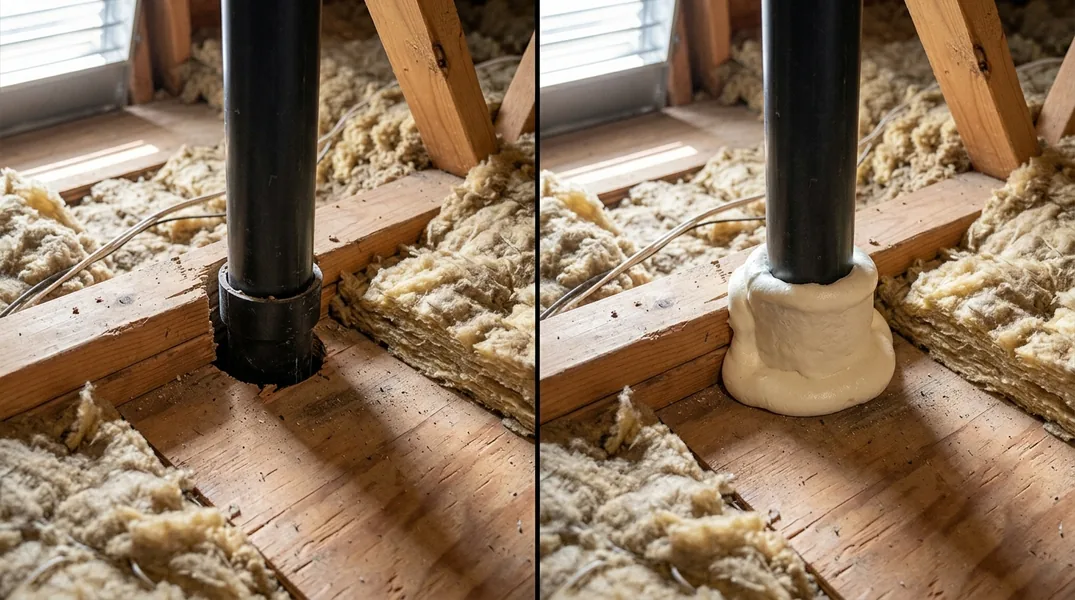
Air sealing addresses one critical problem: air leaks. Gaps around ductwork, electrical penetrations, soffit vents, and other openings allow conditioned air to escape and unconditioned air to enter. In many homes, these leaks account for 15 to 30 percent of heating and cooling losses. Sealing them with caulk, weatherstripping, or foam sealant can deliver noticeable energy savings without replacing existing insulation. If your attic insulation is already at or near code minimum and your main issue is visible air leakage, air sealing alone might be a cost-effective first step.
However, air sealing has a ceiling. It cannot increase your R-value or improve the insulating power of degraded or insufficient insulation. If your existing insulation is thin, wet, or compressed, sealing the air leaks won't solve the underlying thermal resistance problem. Many homeowners discover that after sealing air leaks, their energy bills improve by 10 to 15 percent, but they still feel temperature swings or notice high cooling costs in summer. That's the signal that your insulation depth itself needs attention, not just the gaps around it.
Full Spray Foam Insulation: The Complete Solution and Long-Term Value
Open Cell Spray Foam Insulation and Closed Cell Spray Foam Insulation both seal air leaks and provide high R-value in a single application. Open cell foam delivers approximately R-3.5 to R-3.7 per inch, while closed cell foam provides R-6 to R-7 per inch. This means you can achieve R-38 or R-50 with far less material thickness than traditional fiberglass batts, which offer only R-3.2 to R-3.8 per inch. The foam expands to fill cavities completely, eliminating gaps and creating a continuous thermal and air barrier.
The real advantage emerges over time. Spray foam doesn't settle, compress, or degrade like cellulose or fiberglass. It bonds to surfaces, resists moisture intrusion, and can last 80 years or more. For homeowners in Gulf Breeze and other humid areas, this moisture resistance is invaluable. Closed cell foam, in particular, provides a vapor barrier that protects your attic from the high humidity common in coastal Florida. When you factor in energy savings, durability, and the potential for insulation rebates and insulation rebates, the upfront cost of full spray foam often pays for itself within 5 to 8 years.
How Thick Should Spray Foam Be: Calculating Your Ideal Depth
The question of how thick should spray foam be depends on your R-value target and the type of foam you choose. If you're starting from scratch or replacing old insulation, most homeowners in Florida benefit from 5 to 6 inches of open cell foam (R-17 to R-21) or 3 to 4 inches of closed cell foam (R-18 to R-28). These depths meet or exceed Florida's R-30 to R-38 requirements. However, if you're topping up existing insulation that already provides R-15, you might only need 2 to 3 additional inches to reach your target.
A professional assessment is crucial here. During a free estimate, a technician will measure your current insulation, check for air leaks, and recommend the optimal thickness. They'll also identify any problem areas, such as bypasses over walls or gaps around chimneys, that air sealing alone won't fix. This customized approach ensures you're not paying for more material than necessary while guaranteeing you achieve the thermal performance your home needs.
Attic Spray Foam Insulation Cost in Pensacola: What to Budget
The pricing for spray foam insulation varies based on attic size, foam type, existing conditions, and labor complexity. Open cell foam typically costs between 0.50 and 1.00 dollars per board foot, while closed cell foam ranges from 1.00 to 1.50 dollars per board foot. For a 1,500 square foot attic, a full spray foam installation might cost between 2,500 and 5,000 dollars, depending on thickness and foam type. Air sealing alone, by contrast, might run 500 to 1,500 dollars and deliver faster payback on a per-dollar basis.
The real question is return on investment. The federal insulation tax credit ended on December 31, 2025, so ask your utility company about any current rebates instead. In Pensacola, these incentives can reduce your effective cost significantly. Additionally, the energy savings from full spray foam insulation typically exceed those from air sealing alone, especially in homes with poor existing insulation. When you combine lower utility bills, rebates, and the durability advantage, full spray foam often delivers better long-term value than a piecemeal approach. Contact Pensacola Spray Foam Insulation at (850) 903-5081 to discuss your specific situation and get an accurate quote tailored to your home's needs.
Making Your Decision: Topping Up vs. Starting Over
Deciding between air sealing and full spray foam comes down to three factors: your current insulation depth, your energy goals, and your budget. If your attic already meets R-30 requirements and your main complaint is drafts or uneven temperatures, air sealing might be the right starting point. You'll see quick results and modest costs. However, if your insulation is thin, wet, or degraded, or if you want maximum energy savings and long-term durability, full spray foam is the smarter investment.
Many homeowners in Myrtle Grove and across Pensacola find that a hybrid approach works best: start with air sealing to address obvious leaks, then add spray foam to boost R-value and create a complete thermal barrier. This staged approach lets you spread costs while still achieving excellent results. Whatever path you choose, the key is acting now. Energy costs continue to rise, and every year of inadequate insulation costs money in wasted conditioning. Reach out to Pensacola Spray Foam Insulation today for a professional assessment and discover which solution fits your home and budget.
Looking for a professional spray foam insulation contractor in Pensacola? Pensacola Spray Foam Insulation responds fast for all your spray foam insulation needs.
Get a Free Quote